
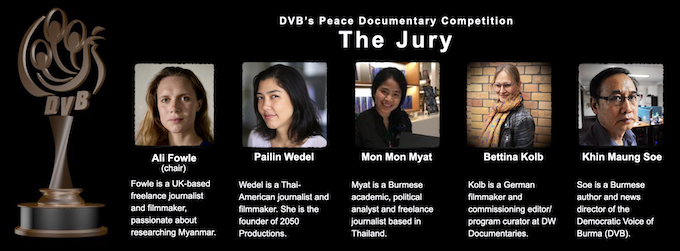
Ten Burmese filmmakers have been selected by an international jury for the Peace Documentary Competition 2022 organised by the Democratic Voice of Burma (DVB).
by Ole Chavannes, 16 september 2022
The winning submissions will be awarded a production budget and professional training for ten weeks and will submit their final films at the beginning of December. DVB hopes that this competition will champion creative voices from Myanmar in non-fiction storytelling.
Stay tuned on DVB.no to watch the results by the end of this year.
‘Exploring diversity’ has been the catchphrase for years of Burma’s first TV travel show ‘Doh Pyay Doh Myay’ (‘Our Land Our Region’). The program managed to explore rarely filmed regions, giving a voice to underrepresented people. The military coup made the editorial team pull over, as journalism became a lethal profession overnight. Now DPDM starts travelling again, but this time around the world.
by Ole Chavannes, 21 augustus 2022
In order to air the weekly program, the editorial team of the Democratic Voice of Burma (DVB) traveled by 4WD car across dangerous roads, to portray all kind of local communities respectfully and in freedom. Until the military seized power on February 1st 2021, declaring all independent media illegal.
The 30 year old independent broadcaster DVB survived by going underground again, radically changing its journalistic practises to keep covering and checking each news event independently. Its national viewership more than doubled online on Burmese.DVB.no and also more international audiences are following the new English.DVB.no news feed.
One and a half years after the coup, thanks to international support, DVB proudly presents the premiere of DPDM Global. The same journalistic formula as before, but safely filmed in countries with (some) press freedom around the world, to portray a wide variety of diaspora with some connection to Myanmar, respectfully and in freedom. DPDM Global explores diversity worldwide.
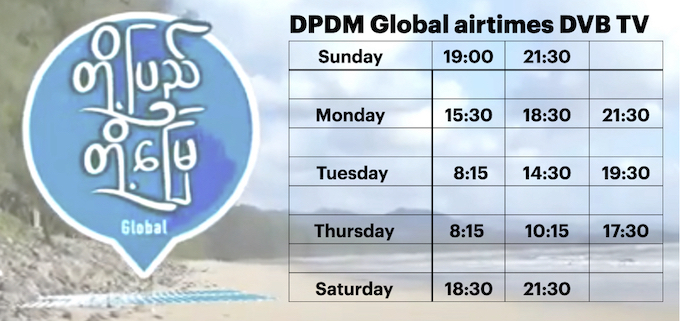
DPDM Global airs first on Sunday 21 August at 7pm Myanmar time on DVB TV, online and as podcast. The 30 minute show airs 13 times a week, according to this TV schedule >
DPDM Global can be followed at YouTube, Facebook and Twitter and is also available as audio podcast (free to download) on Anchor, Spotify, Soundcloud and in the Apple and Google podcast apps. Please share your opinions & ideas by mailing dvb.dpdm@gmail.com.
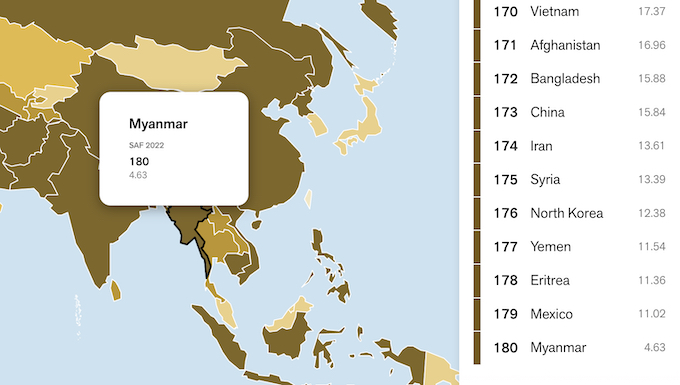 The most unsafe nation in the world for independent reporters is Myanmar (or Burma), states Reporters without Borders (RSF). The Paris based media rights NGO released their 20th World Press Freedom Index, traditionally on the 3rd of May, World Press Freedom Day.(screenshot from RSF Index/safety)
by Ole Chavannes, 03 mei 2022
Burma now ranks 176th out of 180 countries in RSF’s index. Last year, the nation ranked 140th on the index and had declined 36 spots following the military coup on 1 February 2021. RSF developed a new methodology to compile the index, with five new indicators to measure press freedom: the political context, legal framework, economic context, sociocultural context, and security. In this last category, Myanmar scores the lowest ‘score’ in the world.
Since the military coup, the junta has revoked eleven local media licenses, and some news media have been forced to suspend their reporting. More than 160 journalists have been arrested or face criminal charges, and more than 50 of them remain in jail. Three journalists have been killed. The National Unity Government (NUG), the parallel government, released a statement calling on the international community to take action against the junta for journalists who have been arrested, tortured, and killed while doing their jobs inside the country.
Unsurprisingly the Myanmar junta has not said anything about today’s global media freedom day, but last Friday the junta spokesperson general Zaw Min Tun blasted banned exiled media outlets as “ball lifters” for the civilian government in exile. While they may be laughable insults, they help feed a much more dangerous dynamic. A new military-aligned rebel group called Thway Thauk’ or ‘Blood Brothers’, which has killed at least eight people in Mandalay, said recently that it would kill journalists and their family members.